Last checked: 2026-08-29
Knowing what you see on a Budapest river cruise turns a pleasant hour on the water into the best sightseeing session of your trip. The banks of the Danube here have been a UNESCO World Heritage site since 1987, and the standard one-hour loop from the Vigadó tér docks threads the entire listed ensemble: north to Margaret Island, a turn, then south past Gellért Hill before heading back. This guide walks the route in sailing order, with one memorable fact per landmark and — more usefully — which side of the boat to stand on.
One navigation note up front: because the loop turns around, everything passes both sides eventually, but each landmark has one close pass. Parliament is on the Pest (east) bank and passes close northbound; the Castle is on the Buda (west) bank and shows best southbound. Boats vary, but most run this pattern; the night cruise and daytime loops from about €11–12 both follow it.
Before you cast off: Vigadó tér and the docks
Most sightseeing loops leave from the Vigadó tér docks (numbers 5–9) on the Pest embankment, named for the Vigadó concert hall behind them — the ornate Romantic-era hall where Liszt and Wagner performed, and your first landmark before the boat moves. Legenda’s boats use dock 7 here; other operators board at the Akadémia dock near the Chain Bridge, at Dock 42 by Szent István Park, or on the Jane Haining rakpart just south, where Silverline and Duna Cruises tie up. Tram 2 or the M1 metro to Vörösmarty tér puts you a two-minute walk from Vigadó tér.
Board 15 minutes early and go straight to the upper deck — the open-air rail spots on each side fill first, and they are worth more than any bow seat on this route. From the dock you are already looking at Buda Castle directly across the water, so the sightseeing starts before the engine does.
Northbound leg: Vigadó tér to Margaret Island
Leaving the dock, the boat heads upstream — slightly slower against the current, which gives you more seconds per landmark on the most photogenic stretch. Stand on the Pest (east) side.
Széchenyi Chain Bridge
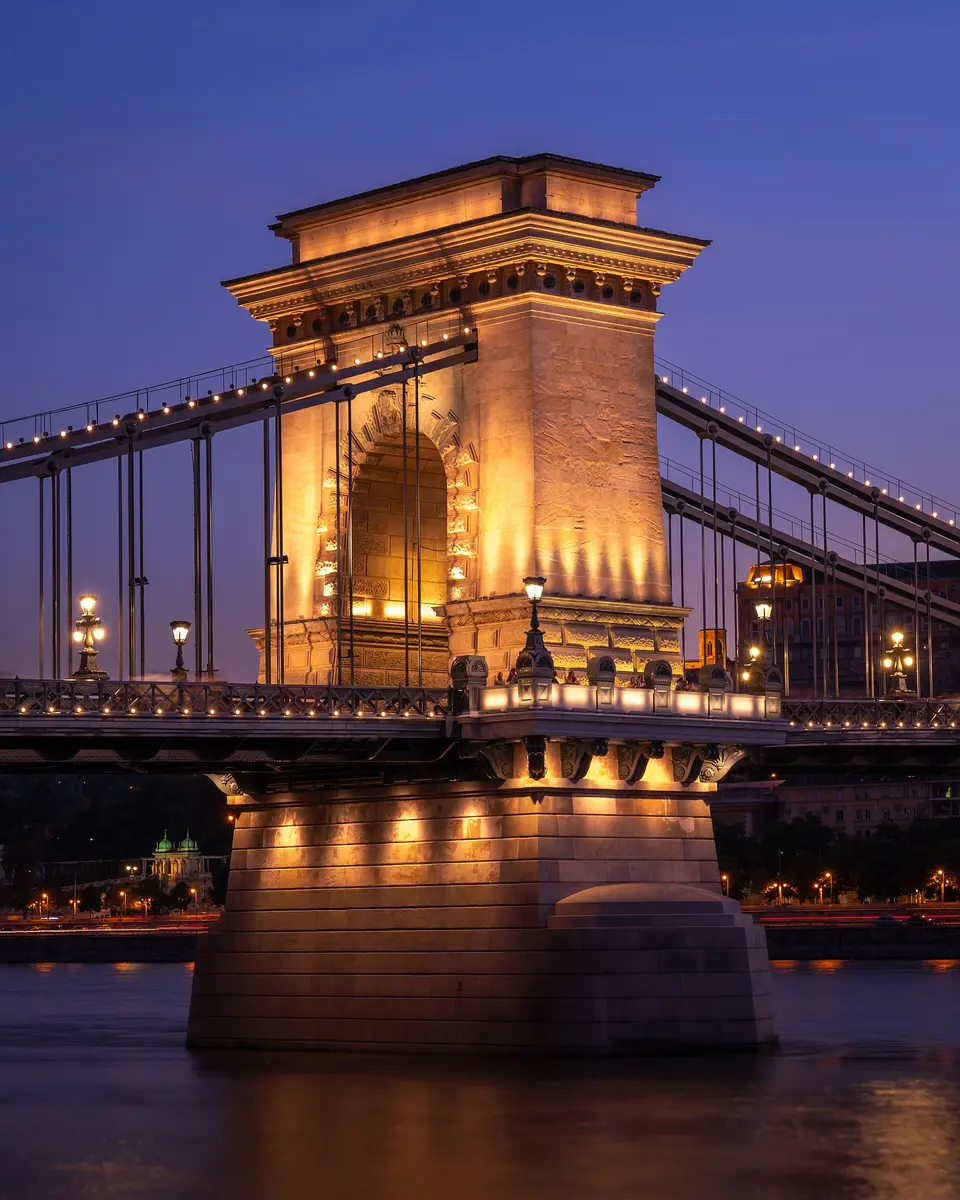
The first bridge you pass under, and the most famous: opened in 1849 as the first permanent bridge across the Hungarian Danube, finally joining Buda and Pest into one city. The stone lions at each end are the city’s unofficial mascots. From water level, the underside of the deck and the chain anchorages are a view no pedestrian gets.
Gresham Palace
Facing the Chain Bridge on the Pest bank: a 1906 Art Nouveau palace built for a London insurance company, now the Four Seasons hotel. Watch for the peacock-gate ironwork as you pass. Visit after? You can walk into the lobby for a look even without a room reservation.
Hungarian Academy of Sciences
Just north of Gresham Palace, the neo-Renaissance seat of Hungary’s scholarly establishment since 1865. The Akadémia boat dock in front of it is where several evening and party boats depart, including the MS Stadt Wien — file it away if your party cruise ticket names that dock.
Hungarian Parliament — the closest pass
The reason to be on the Pest side northbound. Completed in 1904, 96 m to the top of the dome, the largest building in Hungary — and the boat passes close enough that the facade fills your frame. This is the definitive Budapest cruise moment; at night the floodlit version is the city’s signature image. You can also go inside on a timed-entry tour from €43 — our Parliament guide covers tickets and the day-plus-night combo, or book Parliament entry directly. Just south of the building, look for the Shoes on the Danube memorial at the water’s edge; it honors people shot into the river in 1944–45, so point your camera at Parliament, not at mourners.
Margaret Bridge and the Margaret Island turn
The loop’s northern limit: a Y-shaped bridge (rebuilt after WWII) whose middle leg touches the tip of Margaret Island, the city’s car-free park island. Most one-hour loops turn here without stopping; Legenda’s daytime product offers an optional island walk in season. As the boat swings around, cross to the other rail — the second act is on the Buda side.
Southbound leg: the Buda panorama
Downstream now, with the current, along the Buda (west) side. This leg is one continuous hillside composition — castle, church, citadel — which is why it reads better from the river than from anywhere on land.
Fisherman’s Bastion and Matthias Church
High on Castle Hill, the white neo-Romanesque turrets of Fisherman’s Bastion and the diamond-tiled roof of Matthias Church — the coronation church of Hungarian kings. The fact worth repeating: the Bastion was built purely as a viewing terrace, and from the water you are looking at the lookout. Both are visitable on foot; go early morning to beat the tour groups.
Buda Castle
The former royal palace sprawls along the hilltop, museums and galleries behind a baroque facade rebuilt after wartime destruction. Beneath it runs a natural cave system used as a WWII hospital — visitable on a 30-minute guided walk from €17; book the castle caves tour if the idea appeals. The castle’s night illumination, mirrored in the river, is the co-star of every evening cruise.
Várkert Bazár
At the foot of Castle Hill, the ornamental garden terraces and pavilions of the Castle Garden Bazaar step down to the embankment — designed by Miklós Ybl, the architect of the Opera House. Restored in the 2010s, escalators inside take pedestrians up toward the castle: the lazy route up, noted for tomorrow.
Elisabeth Bridge
The white suspension bridge, slung between Gellért Hill and the Pest city center. The original was the only Budapest bridge not rebuilt in its old form after WWII — the 1964 replacement is deliberately modern, a clean white line among the historic spans.
Gellért Hill, Liberty Statue and Citadella
The steep, wooded hill rising straight from the water, crowned by the Citadella fortress and the 14 m Liberty Statue holding her palm leaf aloft since 1947 — visible from almost everywhere in the city, but nowhere better than from directly below on the river. St Gerard (Gellért), the martyred bishop the hill is named for, has his own monument facing the Elisabeth Bridge.
Liberty Bridge and the Great Market Hall
The green wrought-iron Liberty Bridge is the shortest and, many locals say, the prettiest of the spans — look for the turul falcons perched on its pinnacles. At its Pest end stands the Great Market Hall with its Zsolnay-tiled roof: paprika and produce downstairs, lángos upstairs. It anchors the things-to-do itinerary for good reason. Most one-hour loops turn around in the Petőfi–Rákóczi bridge area just downstream, then run back up the middle of the river — a final wide-angle pass of everything you’ve just seen — to Vigadó tér.
Photo cheat sheet: landmark, leg, boat side
| Landmark | Best leg | Boat side |
|---|---|---|
| Chain Bridge | Both (you pass under it twice) | Either — shoot the underside |
| Gresham Palace | Northbound | Pest (east) |
| Academy of Sciences | Northbound | Pest (east) |
| Parliament | Northbound (closest pass) | Pest (east) |
| Margaret Bridge & Island | At the turn | Bow, then either |
| Fisherman’s Bastion & Matthias Church | Southbound | Buda (west) |
| Buda Castle | Southbound | Buda (west) |
| Várkert Bazár | Southbound | Buda (west) |
| Elisabeth Bridge | Southbound | Either |
| Gellért Hill & Liberty Statue | Southbound | Buda (west) |
| Liberty Bridge | Southbound | Either |
| Great Market Hall | Southbound | Pest (east) |
Two honest caveats. Lower-deck window seats suffer glass glare, especially at night — for photos you want the open upper deck, and a layer even in summer, because the river breeze is real. And on floodlight timing: monument illumination switches off around 22:00–23:00 depending on season, so board evening loops by 21:00–21:30 in summer, earlier in winter.
The six bridges, in order
For orientation — and because the bridges are the loop’s chapter markers — the order through the center from north to south is: Margaret Bridge → Széchenyi Chain Bridge → Elisabeth Bridge → Liberty Bridge → Petőfi Bridge → Rákóczi Bridge. The standard one-hour loop passes under the middle four twice and turns just short of the outer two. Each rebuilt span also carries a war story: retreating German forces blew every Danube bridge in Budapest in 1945, so what you sail under is a city’s worth of post-war reconstruction, with only Elisabeth Bridge rebuilt in a deliberately new form.
Does the boat you pick change what you see?
The route barely varies between operators; the viewing platform does. An open upper deck matters more than anything else on the boat — that’s where this guide’s side-switching advice actually works. In winter or rain, an enclosed lower deck saves the trip: Silverline’s Táltos catamaran was built with exactly that in mind, while Duna Cruises’ 19th-century-style paddle-wheel steamboat replicas, such as the 2023-launched Kisfaludy, add period atmosphere at the cheapest prices in town (€8–16). Audio guides also differ — Legenda’s evening product runs commentary in around 30 languages, useful if this page’s landmark list is the part of the cruise you care about. Our best cruises comparison matches boats to priorities in one table.
What you see on a Budapest river cruise by day, sunset and night
Same route, three different cities. Daylight shows detail — roof tiles, statuary, the market hall’s colors — and is best for actually identifying everything in this guide; daytime loops start from about €12. A sunset departure gets golden light on the Buda bank, then the lights coming on. Night is pure spectacle: the floodlit ensemble that made the riverbank famous. Prices as listed on GetYourGuide at the time of writing start from €11 for the night loop — compare all sightseeing cruises for live availability, and see the homepage overview for how the formats differ.
However you time it, this is what you see on a Budapest river cruise: a UNESCO-listed skyline arranged, almost suspiciously well, at boat-deck height. Learn the sides, pick your leg, and the hour organizes itself.
Frequently asked questions
What do you see on a Budapest river cruise?
The standard one-hour loop passes Parliament, Buda Castle, Fisherman's Bastion, Matthias Church, Gellért Hill with the Liberty Statue, the Great Market Hall and six bridges including the Chain Bridge. The whole riverbank is UNESCO-listed.
Which side of the boat is best in Budapest?
Both, at different times. Parliament passes close on the Pest (east) side during the northbound leg; Buda Castle and Gellért Hill are on the Buda (west) side southbound. Move once at the Margaret Island turn.
How long is a Budapest sightseeing cruise?
The standard loop is about one hour: north to Margaret Island, turn, south past the Liberty Bridge area, turn, and back. Dinner and evening cruises stretch the same route to 1.5 hours or more.
Is a day or night cruise better for seeing the landmarks?
Daytime shows detail and is better for spotting everything on this page; night shows the floodlit skyline and is the more spectacular view. Facade lighting switches off around 22:00–23:00, so board night cruises by about 21:00–21:30 in summer.
Do cruises stop at the landmarks?
Standard sightseeing loops don't stop — they are a moving viewpoint. To get off at sights, take the hop-on hop-off boat, or visit Parliament, the Basilica and the Castle on foot before or after your cruise.
Why is the Budapest riverbank UNESCO-listed?
The Banks of the Danube, with the Buda Castle Quarter, were inscribed in 1987 as an outstanding urban landscape — which is why the cruise loop works: the protected ensemble is exactly what the boat sails through.